

How They Work: Receiver Driers & Accumulators
The main job of receiver driers and accumulators in your car's AC system is to store excess refrigerant until it's needed by the evaporator. These components also help remove small amounts of moisture from the refrigerant as it cycles through the system. Inside both receiver driers and accumulators, there's a desiccant, which is similar to those silica gel packets you find in new shoes. The desiccant draws moisture out of the refrigerant to prevent damage to the AC system's internal parts.
Every time you open the system to replace a part, you should also replace the receiver drier. Desiccants come in different types for various refrigerants: XH-5 for R12 and XH-7 & XH-9 for R12 & R134a. Universal receiver driers are described using terms like “#5 flare” or “#6 o-ring,” which refer to the fittings on the driers. For example, a “#6 o-ring” has 3/8” o-ring fittings on both ends.
Receiver Drier
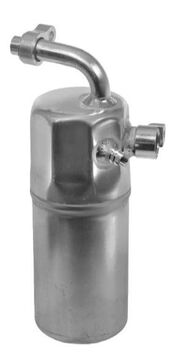
Receiver driers are usually metal and have plugs so you can add pressure switches on the head or stem. The desiccant is typically located at the top of the drier, under the weld. This picture shows a typical universal receiver drier.
Pad Drier
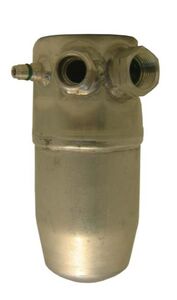
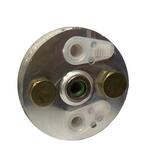
Pad driers have a flat top to accommodate a pad fitting. Like receiver driers, the desiccant is found at the top, under the weld, and they are usually made of alloy. This picture shows a typical pad drier.
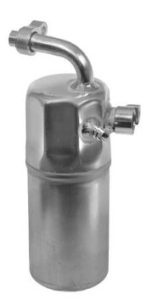
Accumulator
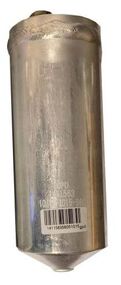
Accumulators are bigger than receiver driers and are usually made from alloy or steel. Inside the accumulator, the desiccant is found as a bag, and there's also a small particle filter on the outlet tube.
For top-quality AC driers and accumulators, check out BuyAutoParts.com. We've got everything you need to keep your car's AC system running smoothly.
