

Most drivers never think about their steering system until something feels wrong. A loose, wandering wheel or a clunking noise on turns is often the first sign that either a rack and pinion or a steering gear box is failing. Knowing which system your vehicle uses is not just trivia. It determines which parts you need, how much the repair costs, and how difficult the job is for a DIY mechanic. This guide breaks down the rack and pinion vs steering gear box debate with the specificity you need to make the right call at the parts counter.
Table of Contents
- What Is a Rack and Pinion Steering System?
- What Is a Steering Gear Box?
- Quick Takeaways
- Which Vehicles Use Which System?
- Side-by-Side Comparison of Both Systems
- Signs Your Steering System Is Failing
- Rack and Pinion Replacement: What to Expect
- Steering Gear Box Replacement: What to Expect
- Frequently Asked Questions
- References
What Is a Rack and Pinion Steering System?
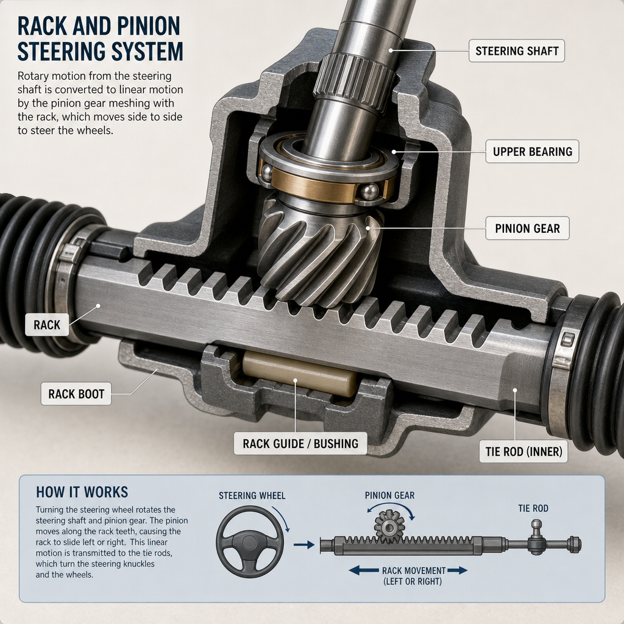
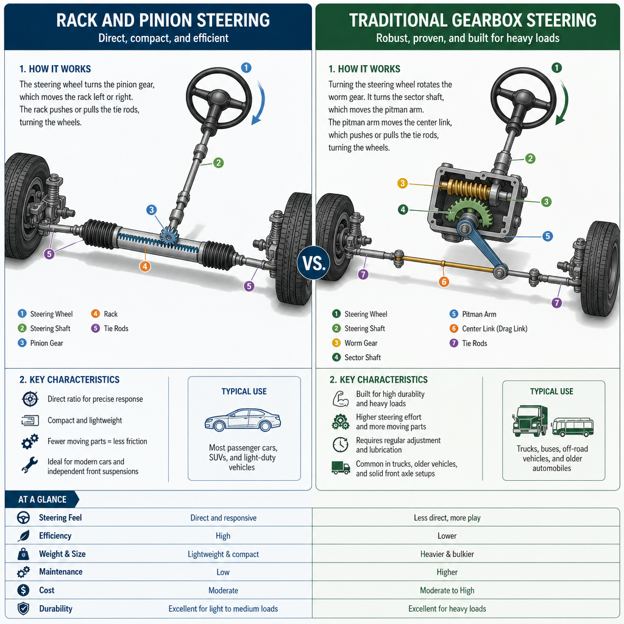
A rack and pinion system translates the rotation of your steering wheel into linear motion using two components: a circular gear called the pinion, which meshes with a toothed bar called the rack. When you turn the wheel, the pinion rotates and moves the rack left or right, pushing the tie rods and turning the wheels. The design is compact, mechanically direct, and provides sharp steering feedback.
This system became the dominant choice for passenger cars starting in the 1980s because it is lighter, requires fewer components, and delivers better road feel than older recirculating-ball designs. Nearly every front-wheel-drive car on the road today uses some form of rack and pinion, whether it is hydraulically assisted, electrically assisted (EPS), or purely manual.
The trade-off is durability under heavy load. Rack and pinion units are not designed for the axle loads and constant stress that trucks and SUVs with solid front axles endure. That is where the gear box still earns its keep.
What Is a Steering Gear Box?
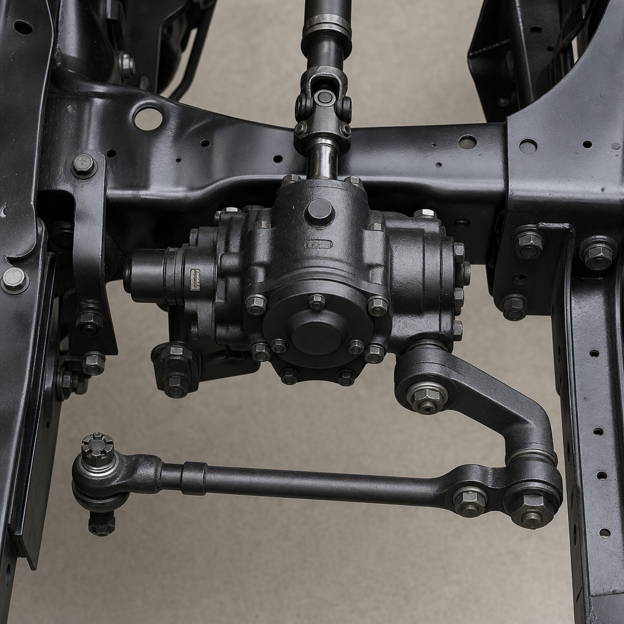
A steering gear box, also called a recirculating ball or worm-and-sector steering box, converts steering wheel input through a series of ball bearings that circulate inside a threaded channel around a worm gear shaft. The output shaft connects to a Pitman arm, which moves a series of linkages including the center link, idler arm, and tie rods to steer the wheels.
This system uses more components than rack and pinion, which means more potential failure points. But the gear reduction built into the box makes it capable of handling significantly higher steering loads. That is why full-size pickup trucks like the Ford F-250, Chevrolet Silverado HD, and heavy-duty SUVs traditionally used steering gear boxes rather than rack and pinion setups.
Steering feel is noticeably different. The gear box system introduces more play and a softer, less direct response compared to rack and pinion. Experienced drivers of older trucks know this as normal, but it can feel vague to someone used to a modern car.
Quick Takeaways
| Key Insight | Explanation |
|---|---|
| Rack and pinion is the modern standard for cars | Most passenger cars built after 1985 use rack and pinion due to its compact size and direct steering feel. |
| Steering gear boxes are built for heavy loads | Trucks, full-size SUVs, and vehicles with solid front axles still rely on gear boxes because of their higher load capacity. |
| Rack and pinion replacement is typically more expensive | A complete rack and pinion unit can run $200 to $600 for the part alone, while gear boxes vary widely by vehicle. |
| Both systems show similar early warning signs | Loose steering, fluid leaks, and clunking noises on turns are red flags for either system. |
| Power steering fluid leaks mean different culprits | On rack and pinion systems, leaks often come from the rack seals. On gear box systems, leaks usually come from the input or output shaft seals. |
| EPS systems have no fluid at all | Electric power steering (EPS) rack and pinion units have no hydraulic fluid. Diagnosis requires a scan tool, not a dipstick. |
| DIY difficulty differs significantly | Rack and pinion swaps typically require a wheel alignment afterward. Gear box replacements often require Pitman arm puller tools most DIYers do not own. |
Which Vehicles Use Which System?
Identifying your steering system before ordering parts will save you time and money. The fastest method is to look under the hood and trace the steering column down to where it connects. If it ends at a compact, cylindrical housing mounted directly to the subframe with two tie rods coming out of each side, you have rack and pinion. If it connects to a box-shaped unit on the frame rail with a single arm dropping down from the output shaft, you have a steering gear box.
Vehicles Typically Using Rack and Pinion
Front-wheel-drive passenger cars, most unibody crossovers and SUVs, sports cars, and smaller rear-wheel-drive platforms almost universally use rack and pinion. Examples include the Honda Civic, Toyota Camry, Ford Mustang (1994 and newer), Chevrolet Malibu, and virtually every European sedan on the market. If you drive a daily commuter car built in the last 30 years, the odds strongly favor rack and pinion.
Vehicles Typically Using Steering Gear Boxes
Body-on-frame trucks and SUVs with solid front axles are the primary users of steering gear boxes. This includes the Ford F-250 and F-350 Super Duty, Chevrolet and GMC 2500HD and 3500HD, older Jeep Wranglers (TJ and older generations), Toyota Land Cruisers, and full-size vans like the Ford E-Series. Older vehicles in general, regardless of type, are more likely to have gear boxes simply because the technology predates modern rack and pinion adoption.
Side-by-Side Comparison of Both Systems
Understanding how these two systems compare across the factors that matter most to a working mechanic or serious DIYer makes part selection and repair planning much clearer.
| Feature | Rack and Pinion | Steering Gear Box |
|---|---|---|
| Primary vehicle types | Passenger cars, crossovers, most unibody SUVs | Full-size trucks, body-on-frame SUVs, older vehicles |
| Steering feel | Direct, responsive, high road feedback | Softer, more dampened, slight play is normal |
| Component count | Low (rack, pinion, inner/outer tie rods) | High (box, Pitman arm, center link, idler arm, tie rods) |
| Load handling capacity | Moderate, suited for lighter vehicle platforms | High, designed for heavy payload and towing stress |
| Common failure points | Rack seals, inner tie rod ends, pinion bearing | Input shaft seal, sector shaft seal, Pitman arm wear |
| Typical part cost (replacement unit) | $150 to $600 depending on vehicle and power assist type | $80 to $400 depending on vehicle application |
| Required post-install service | Wheel alignment almost always required | Alignment recommended but less universally required |
"The steering system is the primary interface between driver intent and vehicle response. Any looseness or inconsistency in that system creates a compounding safety risk that worsens with every mile driven." - SAE International, Vehicle Dynamics and Safety Technical Committee
Signs Your Steering System Is Failing
Both rack and pinion and steering gear box systems give similar early warnings, but the diagnostic steps differ. Recognizing which symptom points to which component will keep you from replacing the wrong part.
Loose or Wandering Steering
Excessive play in the steering wheel before the vehicle responds is one of the most common complaints. On a rack and pinion vehicle, worn inner tie rod ends or a damaged rack itself are the most likely causes. On a gear box vehicle, the box can often be adjusted using the adjustment screw on top of the unit to remove slack, which is a repair option that does not exist with rack and pinion.
A common mistake is adjusting the gear box too tight. Overtightening eliminates the play but causes the steering to bind in the center, creating a different and more dangerous handling problem.
Power Steering Fluid Leaks
On hydraulic rack and pinion systems, fluid leaks typically appear at the ends of the rack where the seals have deteriorated. You will often see fluid weeping from the accordion-style boots. On gear box systems, leaks most commonly appear at the input shaft where the steering column connects or at the output Pitman arm shaft. In both cases, continuing to drive with low power steering fluid will accelerate internal wear dramatically.
Clunking or Grinding on Turns
A metallic clunk when turning at low speeds often points to worn inner tie rod ends on rack and pinion setups or a worn Pitman arm on gear box vehicles. Grinding that varies with steering input can indicate a failing rack bearing or worn ball bearings inside the gear box itself. Neither symptom resolves on its own.
Rack and Pinion Replacement: What to Expect
Replacing a rack and pinion unit is one of the more involved suspension jobs a DIY mechanic can take on, but it is well within reach for anyone with a solid set of tools and a free afternoon. The job requires removing the front wheels, disconnecting the tie rod ends with a separator tool, disconnecting the power steering lines (on hydraulic units), removing the steering shaft coupler, unbolting the rack from the subframe, and reversing the entire process with the new unit.
Parts You Need Beyond the Rack Itself
A smart rack and pinion replacement includes new outer tie rod ends while you already have the front end apart. If the inner tie rod ends are not pre-installed on the replacement rack, add those to your order as well. On hydraulic systems, plan to flush and refill the power steering fluid. Skipping a wheel alignment after this job is a false economy. Toe settings almost always shift when the tie rod ends are disconnected and reinstalled.
Remanufactured vs. New Rack Units
Remanufactured rack and pinion units are a legitimate option for most vehicles and are typically 30 to 50 percent less expensive than new units. The key is buying from a supplier that pressure-tests each unit and provides a meaningful warranty. At BuyAutoParts.com, remanufactured rack and pinion units are tested and come with a warranty that gives you real coverage, not a 30-day window. Cheap offshore units from unknown suppliers are where DIYers get burned with premature seal failures.
Pro tip: When installing a new rack on a hydraulic power steering system, cycle the steering lock to lock slowly several times before starting the engine to pre-lubricate the rack seals with fluid. Dry-starting a new rack accelerates early seal wear significantly.
Steering Gear Box Replacement: What to Expect
Steering gear box replacement is often simpler in terms of total component count compared to rack and pinion, but it requires a specific tool most DIYers do not already own: a Pitman arm puller. The Pitman arm is pressed onto the sector shaft with a taper fit and cannot be removed safely with a standard pickle fork or hammer technique without damaging the new box or the arm itself.
Adjustment Before Replacement
Unlike rack and pinion, a steering gear box has an adjustment capability built in. Before replacing the entire unit, check whether the excess steering play can be corrected by adjusting the sector shaft preload screw, typically located on the top of the box. This adjustment should only be made with the front wheels on the ground and the steering centered. Adjust in small increments, no more than a quarter turn at a time, and recheck feel after each adjustment.
In practice, boxes that have developed internal wear beyond a certain threshold will not respond well to adjustment. If the box feels tight at center but loose off-center, internal wear has progressed past the adjustment window and replacement is the correct answer.
What to Inspect While the Box Is Out
With the gear box removed, inspect the Pitman arm, center link, and idler arm for wear. These components absorb the same stress cycles as the box itself. Replacing only the gear box while leaving a worn idler arm or center link creates the same loose steering feel within months. The additional parts are inexpensive relative to the labor already invested.
Frequently Asked Questions
Can I convert from a steering gear box to rack and pinion?
Conversion kits do exist for some popular platforms, particularly for older muscle cars and off-road trucks. Companies like Unisteer and Borgeson make bolt-on rack and pinion conversions for applications like early Ford Broncos and classic GM trucks. However, these conversions are not inexpensive and require significant fabrication knowledge. For most daily drivers, replacing the existing gear box is the practical choice.
How long does a rack and pinion unit typically last?
A well-maintained rack and pinion system on a passenger car commonly lasts 100,000 to 150,000 miles. Road conditions matter enormously. Vehicles driven frequently on rough, potholed roads see rack and inner tie rod wear accelerate compared to highway-dominated driving. Contaminated power steering fluid is the number-one cause of premature seal failure on hydraulic rack systems.
Is rack and pinion steering safer than a gear box?
Neither system is inherently safer when properly maintained. The direct feedback of rack and pinion can help drivers detect road hazards more quickly, which some safety researchers cite as an advantage. But a well-functioning gear box on a truck designed around that system performs exactly as intended. The safety risk comes from neglected maintenance, not from choosing one design over the other.
What does it cost to have a rack and pinion replaced at a shop?
Total shop cost for rack and pinion replacement including labor typically runs from $500 to $1,200 depending on the vehicle. Labor alone is often 2 to 4 hours at shop rates. Add the cost of a wheel alignment, which runs $80 to $150, and the total is significant. DIY replacement using a quality remanufactured unit from a supplier like BuyAutoParts.com can cut total cost by 40 to 60 percent while using the same quality of parts a shop would install.
How do I know if my power steering is hydraulic or electric?
The simplest check is to look for a power steering fluid reservoir under the hood. If there is a reservoir with a cap labeled for power steering fluid, the system is hydraulic. If no reservoir exists and the steering column connects directly to an electric motor assist unit near the rack or column, you have an electric power steering system. EPS vehicles have no fluid to check and no pump to fail, but the assist motor and control module can fail and require scan tool diagnosis.
Can I drive with a leaking rack and pinion?
A slow leak that is closely monitored is different from a fast leak. A minor seep that drops fluid level slowly can be topped off in the short term, but the underlying seal damage will worsen. Driving with low or absent power steering fluid on a hydraulic system will damage the pump within miles. More critically, severe rack failure can result in total loss of steering assist, which is a genuine safety emergency. Address any steering fluid leak promptly rather than treating it as a nuisance.
Have you replaced a rack and pinion or steering gear box yourself? Share what worked, what surprised you, or what you wish you had known before starting the job.
References
- SAE International: Technical standards and research on vehicle steering and chassis systems
- NHTSA: Federal safety data and defect investigations related to steering system failures
- Consumer Reports: Long-term vehicle reliability data covering steering system failure rates across makes and models
- Statista: Automotive parts market size and aftermarket replacement part sales statistics
- ASE (National Institute for Automotive Service Excellence): Professional standards for steering and suspension diagnosis and repair
