

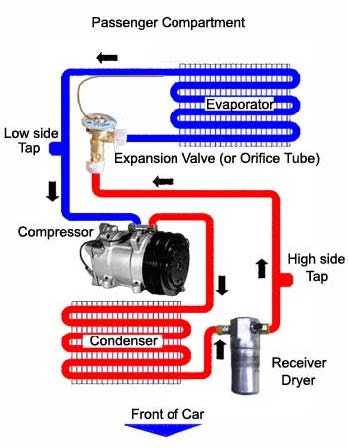
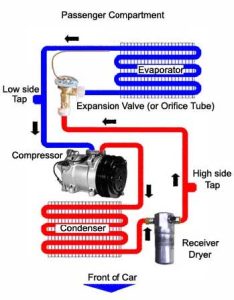
In your car's A/C system, the compressor is powered by a pulley connected to the engine's crankshaft. The cooling process hinges on creating pressure changes between the condenser and evaporator. When refrigerant enters the evaporator, it absorbs heat from the cabin air, causing it to evaporate and carry the heat away. This refrigerant vapor then moves to the condenser, where it is compressed, turning into a liquid and releasing the absorbed heat.
High Side (Red Side): This part of the system starts at the discharge side of the compressor. It moves through the condenser (where heat is transferred and condensation happens), the receiver drier, and ends at the expansion valve. The compressor increases the pressure of the low-pressure vapor from the evaporator, so the high-pressure vapor can release heat at the condenser. The expansion valve then slows down the refrigerant and changes its pressure.
Low Side (Blue Side): This side begins at the expansion valve, which creates low pressure. The refrigerant then moves to the evaporator, where it absorbs heat from the vehicle's interior. It travels back to the compressor, where it’s turned into high pressure, starting the cycle all over again.
