

The AC system includes the compressor, condenser, evaporator and accumulator/receiver-dryer. The key to the cooling function of an AC system is to maintain the pressure of the refrigerant either under high-pressure or low-pressure, as needed. As with any part of the automobile, the AC system can also get contaminated with impurities, making it function improperly. In such cases, flushing an AC system will remove the impurities and make it work properly. The video below describes how to flush an AC system.
Video Transcript:
Next we are going for flushing a system in case we have a compressor that comes apart internally and contaminates the system, we might have metal shavings. What you'd want to do with the system completely installed minus the compressor: you wanna shoot the flush fluid in one side of the compressor hose fittings using sharp air to push the fluid through the complete system and coming out of the other port.
Steps to Flushing A/C System
1. A/C system refrigerant must be completely recovered using approved equipment in accordance with local, state, and federal laws.
2. Disconnect all hoses from components to be flushed. Remove the expansion valve or orifice tube which can be located in the liquid line or at the condenser or evaporator.
3. Remove the cap. Add flush to cylinder. Replace the cap. All flush cylinder connections must be tight.
4. It is generally advised to first “back-flush”, flushing from outlet to inlet on condensers and evaporators, to dislodge debris. Then, flush the component from inlet to outlet.
5. To prevent spraying of flush, oil, and other debris, attach a hose or optional flush capture hose to the exit end of the component to be flushed. Place the hose in a suitable container to capture the used flush solvent.
6. With the cylinder in an upright position, pressurize flush container or attach compressed air to cylinder and fill to 70-100 psi.
7. Insert the tip of the flush gun into the component to be flushed. Press the handle on the gun to release flushing agent. Continue to flush until all contaminants have been removed. Repeat, as necessary.
8. Dispose of flush solvent in accordance with local, state, and federal laws.
9. Make A/C system repairs and evacuate for a minimum of 30 minutes to make sure system will hold a vacuum.
10. Add refrigerant and perform a leak and performance test.
Note: Once the flush gun is connected to the cylinder, it should not be removed.
The refrigerant and oil in an AC system are vital for its proper functioning. It is advised to check for the proper level of the refrigerant or oil as suggested by the manufacturer. The refrigerant forms the base of the air conditioning system. The varying pressure of the refrigerant from one component to the other is what causes the effective cooling of the passenger compartment. The oil used in the system lubricates the AC components, allowing them to run smoothly and preventing them from premature wear. During the process of passing the refrigerant under high and low pressures, the components get heated. The lubricant oil cools down the AC components and allows them to function properly.
Contamination:
The refrigerant and oil circulate through the refrigeration loop during compressor operation. Over time, it will get contaminated with rust due to moisture, desiccant or metal particles from a failed compressor. These impurities will travel with the refrigerant oil mixture and settle throughout the system.
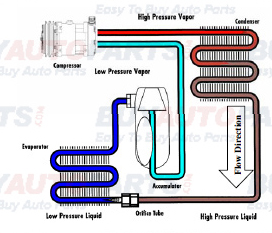
If a new compressor is placed in a dirty refrigerant system, the new compressor will suck in loose contamination particles and eventually fail quickly. Inspect the oil and expansion devices for signs of grit or foreign particles. If foreign particles are present, it is imperative that the system is fluid flushed.
Clean Orifice Tube

Dirty Orifice Tube

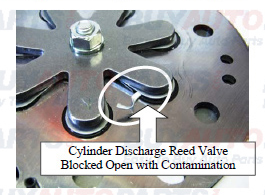
The picture above shows a clean and dirty orifice tube. The system with a dirty orifice tube must be flushed before a new compressor can be installed. If not, damages like a blocked discharge valve, as shown in the image below, will occur.
When flushing a system, never flush the compressors, expansion valves, orifice tubes, receiver driers or accumulators. These components should be replaced with new parts.
System Evacuation:
System Evacuation is the process where moisture and air are removed from the system. It is usually carried out before charging the system with refrigerant or while replacing AC parts. A thorough evacuation is necessary as any moisture or air in the refrigerant or the AC system will reduce the overall efficiency and it could be detrimental to the entire AC system. It is important to note that water boils at specific temperatures and pressures according to the following table:
| Water Boils under a Vacuum | |
| System Vacuum Inches Hg | Boiling Point Degrees Fahrenheit |
| 24.04 | 140 |
| 25.39 | 130 |
| 26.45 | 120 |
| 27.32 | 110 |
| 27.99 | 100 |
| 28.50 | 90 |
| 28.89 | 80 |
| 29.18 | 70 |
| 29.40 | 60 |
| 29.66 | 50 |
| 29.71 | 40 |
| 29.76 | 30 |
| 29.82 | 20 |
| 29.86 | 10 |
| 29.87 | 5 |
Warning: Vacuum pumps with contaminated oil will not be capable of reaching the vacuum level necessary to boil water. It is critical to maintain all equipment per the manufacturer's recommendation. Failure to do so can result in newly repaired systems leaving the shop with moisture contamination.
